
The importance of power batteries as the main power source for new energy vehicles is self-evident. In the actual use of vehicles, the battery will face complex and varied operating conditions. In order to improve the driving range, vehicles need to arrange as many battery cells as possible in a certain space, so the space of the battery pack on the vehicle is very limited. Batteries generate a large amount of heat during vehicle operation and accumulate over time in relatively small spaces. Due to the dense stacking of battery cells inside the battery pack, it also makes it relatively difficult to dissipate heat in the middle area, exacerbating the temperature inconsistency between the cells. As a result, it will reduce the charging and discharging efficiency of the battery and affect its power; In severe cases, it can also lead to thermal runaway, affecting the safety and lifespan of the system.
The temperature of power batteries has a significant impact on their performance, lifespan, and safety. At low temperatures, lithium-ion batteries may experience an increase in internal resistance and a decrease in capacity. In extreme cases, this can lead to the freezing of the electrolyte and the inability of the battery to discharge. The low-temperature performance of the battery system is greatly affected, resulting in a decline in the power output performance and reduced driving range of electric vehicles. When charging new energy vehicles under low temperature conditions, the BMS generally heats the battery to a suitable temperature before charging. If not handled properly, it can cause instantaneous voltage overcharging, resulting in internal short circuits, which may further lead to smoking, fire, and even explosions. The safety issues of low-temperature charging in electric vehicle battery systems have greatly restricted the promotion of electric vehicles in cold regions.
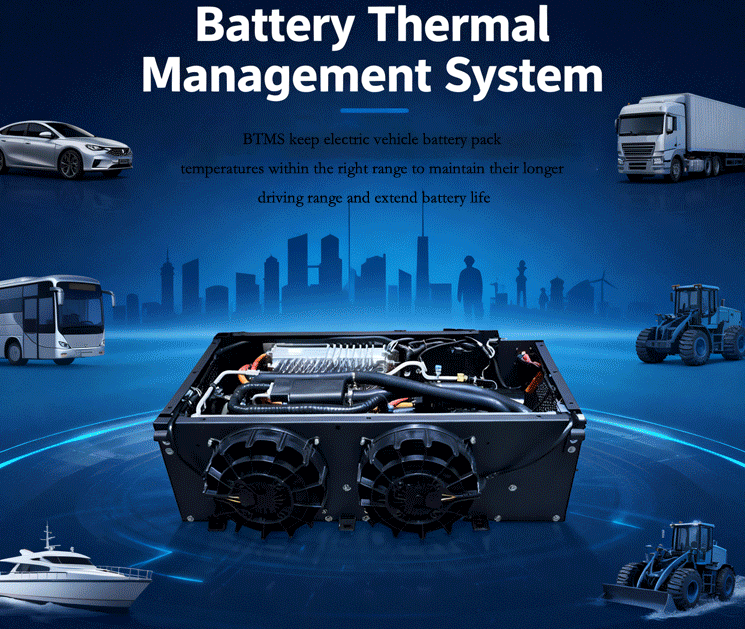
Battery thermal management is one of the important functions in BMS, mainly to ensure that the battery pack can always operate within a suitable temperature range, thereby maintaining the optimal working state of the battery pack. The thermal management of batteries mainly includes functions such as cooling, heating, and temperature balancing. The cooling and heating functions are mainly adjusted according to the possible impact of external environmental temperature on the battery. Temperature balance is used to reduce the temperature difference inside the battery pack and prevent rapid decay caused by overheating of a certain part of the battery.
Generally speaking, the cooling modes of power batteries are mainly divided into three categories: air cooling, liquid cooling, and direct cooling. The air cooling mode utilizes natural wind or cooling air from the passenger compartment to pass through the surface of the battery for heat exchange and cooling. Liquid cooling generally uses independent coolant pipelines to heat or cool power batteries. Currently, this method is the mainstream for cooling, as used by Tesla and Volt. The direct cooling system eliminates the cooling pipeline of the power battery and directly uses refrigerant to cool the power battery.
1. Air cooling system:
Early power batteries, due to their small capacity and energy density, were often cooled by air cooling. Air cooling is divided into two categories: natural air cooling and forced air cooling (using fans), which use natural air or cold air from the cab to cool the battery.
Typical representatives of air-cooled systems include Nissan Leaf, Kia Soul EV, etc; At present, the 48V batteries of 48V micro hybrid vehicles are generally arranged in the passenger compartment and cooled by air cooling. The air cooling path diagram of a certain power battery is shown in Figure 2. The structure of the air-cooled system is relatively simple, the technology is relatively mature, and the cost is relatively low. However, due to the limited heat carried away by the air, its heat transfer efficiency is low, and the internal temperature uniformity of the battery is poor, making it difficult to achieve precise control of the battery temperature. Therefore, air-cooled systems are generally suitable for situations with short driving range and light vehicle weight.
2. Liquid cooling system
The liquid cooling mode refers to the battery using a cooling liquid to exchange heat, and its schematic diagram is shown in Figure 3. Coolant is divided into two types: direct contact with battery cells (silicone oil, castor oil, etc.) and contact with battery cells through water channels (water and ethylene glycol, etc.); Currently, mixed solutions of water and ethylene glycol are commonly used. Liquid cooling systems generally add a chiller coupled with the refrigeration cycle, which takes away the heat from the battery through the refrigerant; Its core components are the compressor, chiller, and water pump. The compressor, as the power source for refrigeration, determines the heat transfer capacity of the entire system. The chiller plays a role in the exchange of refrigerant and coolant, and the amount of heat exchange directly determines the temperature of the coolant. The water pump determines the flow rate of the coolant in the pipeline, and the faster the flow rate, the better the heat transfer performance, and vice versa.
3. Direct cooling system:
The direct cooling system uses the refrigerant of the air conditioning system to directly cool the power battery, as shown in Figure 11. The evaporator of the air conditioning system is directly installed in the battery system, and the refrigerant evaporates in the evaporator to directly remove the heat generated by the battery system, thereby achieving faster and more effective cooling process. At present, there are relatively few models that use direct cooling, with the most typical being the BMW i3. Due to the absence of intermediate heat exchange between liquids, the refrigeration system has a compact structure, higher cooling efficiency (3-4 times higher than liquid cooling), and relatively lower cost. But the problem lies in the fact that due to the gas-liquid conversion of refrigerant in the pipeline, the control of the entire system is relatively complex and the temperature uniformity is poor. And it has high requirements for high pressure resistance and sealing of the system, which poses a significant risk for its application in the entire vehicle.
Post time: Mar-27-2026


