
Overview and Application
In conventional fuel-powered commercial vehicles, hydraulic steering pumps are driven directly by the internal combustion engine. For battery-electric and fuel-cell commercial vehicles, the combustion engine is removed, so an independently powered electric steering pump, also known as electro-hydraulic power steering pump (EHPS / EPHS), is required to deliver pressurised hydraulic oil to the steering gear and provide steering assistance. This setup retains the high assist capacity of proven hydraulic steering gears, making it suitable for heavy-duty trucks, coaches, sanitation trucks and engineering vehicles with high steering loads. Pure electric EPS is widely adopted for passenger cars and light-load vehicles and is not covered in this document.
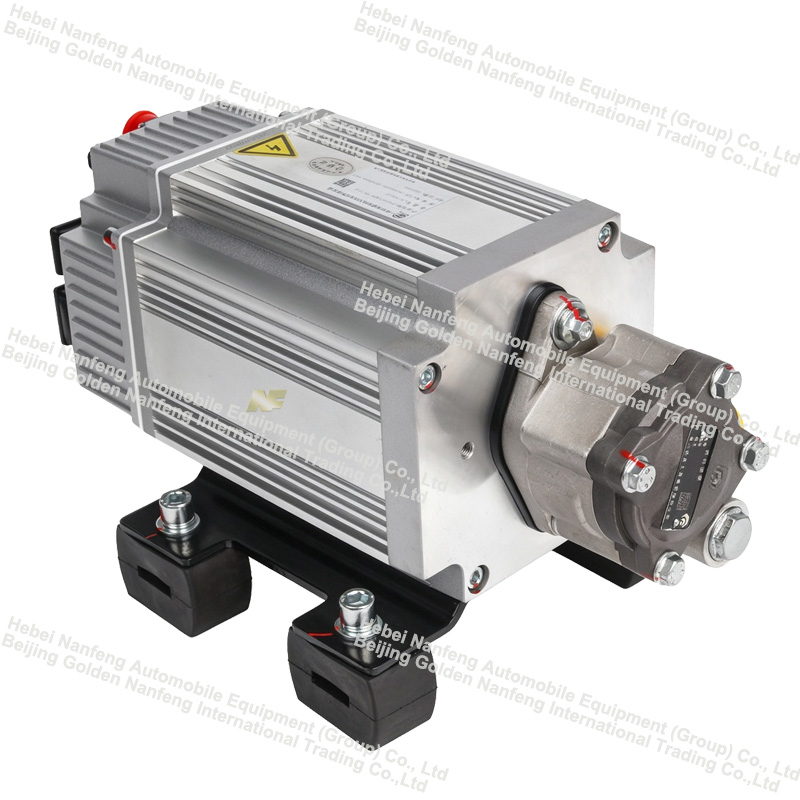
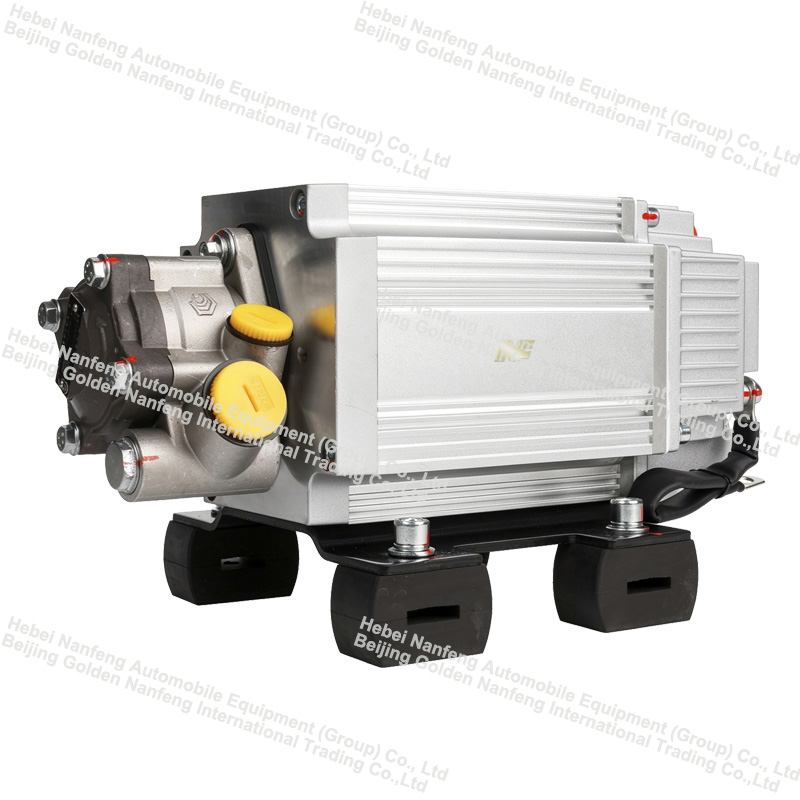
A complete assembly generally consists of a hydraulic pump cartridge, permanent-magnet drive motor, integrated controller, oil reservoir, relief valve, pressure sensor and CAN communication interface. The controller receives signals from the vehicle VCU, steering angle sensor and speed sensor, and adjusts motor speed on demand to match flow rate with operating conditions. The motor runs at low speed when the vehicle travels straight to cut power consumption; flow rises during low-speed manoeuvres, U-turns and bus stop entry and exit to maintain light steering feel. Certain variants also supply auxiliary hydraulic flow for cab tilt systems.
The core advantage of this product is decoupling the steering assist system from the vehicle traction motor. It operates independently of drive motor speed, adapts well to frequent start-stop cycles and supports modular chassis layout. It has become the mainstream steering assist solution for new energy commercial vehicles in China.
Classification and Working Principles
Based on pump cartridge construction, mass-produced electric steering pumps for commercial vehicles fall into three main categories: external gear type, vane type and three-screw type.
1. External Gear Electric Steering Pump
The motor drives a pair of meshing external gears through a coupling. On the gear disengagement side, a low-pressure suction cavity forms, drawing hydraulic oil into gear tooth spaces. The oil is carried by rotating teeth toward the meshing side. As gear teeth mesh, the volume between adjacent teeth shrinks and the oil is pressurised and discharged. An integrated relief valve limits maximum system pressure and protects the steering circuit from overload.
This design features a simple structure with few precision mating surfaces. It tolerates minor contamination in hydraulic oil, withstands vibration and shock well and offers controlled cost. Its main drawbacks are inherent flow pulsation generated by gear meshing, relatively high noise, noticeable internal leakage at low speed and moderate energy efficiency. It is widely used on economical electric coaches, light-duty trucks, sanitation vehicles and modified engineering equipment.
2. Vane Electric Steering Pump
A rotor with radial slots rotates eccentrically inside a stator ring. Vanes slide radially outwards under centrifugal force and hydraulic pressure, keeping their tips in continuous contact with the stator inner wall. Multiple independent sealed chambers are formed between adjacent vanes, the rotor and the stator. Chamber volume expands in the suction zone to draw in oil. When the chamber moves to the discharge zone, volume contracts and hydraulic oil is pressurised and delivered. Balanced double-acting vane structures are preferred for commercial vehicles, which balance radial hydraulic forces and reduce bearing loads.
Vane pumps deliver flow with low pulsation and run quieter than gear pumps. They maintain stable flow at low rotational speed, which fits the frequent low-speed steering cycles of city buses, and achieve higher volumetric efficiency. The main limitation is high sensitivity to oil cleanliness; particulate contaminants can easily scratch the stator and vane surfaces. Vanes are consumable components, so strict oil change intervals must be followed. Pressure fluctuation may occur during cold start due to oil viscosity variation. Typical applications include standard city electric buses and medium-duty electric trucks.
3. Three-Screw Electric Steering Pump
One driving screw and two driven screws rotate synchronously inside the pump housing. The screw threads and housing form continuous axial sealed cavities. Hydraulic oil enters from the suction end, is trapped inside thread cavities and is conveyed axially toward the discharge port as the screws rotate. Pressure builds during axial transportation, without the periodic volume compression seen in gear and vane pumps.
Three-screw pumps produce nearly pulse-free flow and achieve the lowest noise level among the three types. They have low friction losses, high overall efficiency and stable pressure output at low speed, with low wear during prolonged continuous operation. However, they demand extremely high machining precision for screw profiles and clearances, leading to high manufacturing cost. They also require tight control over oil viscosity and cleanliness, occupy larger chassis packaging space and are difficult to repair on-site. They are mainly specified for premium coaches and high-end electric heavy-duty trucks.
Major Manufacturers at Home and Abroad
Overseas Suppliers
1. ZF Friedrichshafen AG (Germany) – A leading supplier for commercial vehicle steering systems. Its EPHS electro-hydraulic steering pumps support ADAS-enabled adaptive steering and on-demand flow control. Widely adopted by major global OEMs for heavy trucks, coaches and hydrogen-powered vehicles.
2. Bosch (Germany) – Mature Servotwin electro-hydraulic steering portfolio. Its hydraulic control integrates well with vehicle electronic architecture and driver-assistance functions, delivering stable high-pressure performance. It has broad application across European and Asian commercial vehicle platforms.
Domestic Suppliers
1. Hebei Nanfeng Automobile Equipment (Group) Co., LTD – Capable of developing and mass-producing the full range of electric steering pumps including gear, vane and three-screw versions. It supplies new energy commercial vehicle OEMs worldwide and provides customised solutions tailored to customer requirements on displacement, working pressure, CAN protocol and installation envelope. The company also supplies pneumatic auxiliary components such as air compressors for the same vehicle platforms.
Selection Guidelines
Gear pumps are preferred for cost-sensitive projects with harsh operating conditions and limited maintenance support. Vane pumps represent a balanced choice for city buses and medium-duty trucks. Three-screw pumps are selected for premium models with strict requirements on noise, steering feel and continuous reliability. Apart from displacement and rated pressure, selection must also consider vehicle voltage class, CAN communication protocol, thermal management, packaging constraints and functional safety strategy.
Post time: Nov-26-2026


