
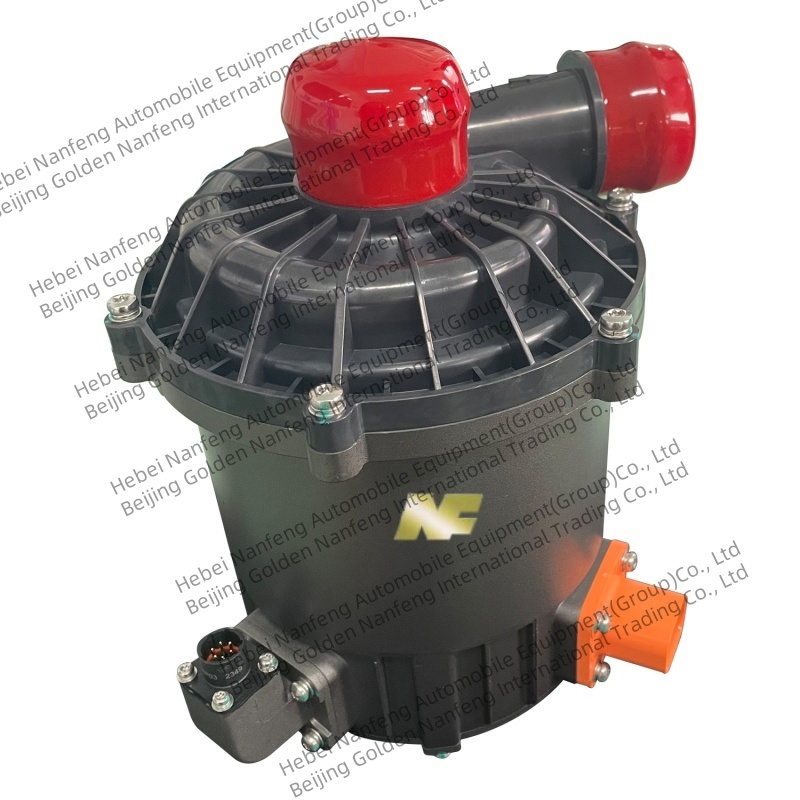
EV Water Pump (Electric Vehicle Electronic Water Pump) is the core power component of the thermal management system for new energy vehicles. It replaces the mechanical water pump driven by the engine belt in traditional fuel vehicles and provides power for the circulation of coolant through the rotation of the impeller driven by electricity. It is the “power heart” that connects PTC heaters, batteries, motors, electronic control and other heat dissipation/heating components, directly determining the coolant flow rate and heat transfer efficiency of the vehicle’s thermal management circuit, and adapting to the full electrification thermal management needs of electric vehicles without engines.
Core Basic Information
Full name: Electric Vehicle Water Pump, also commonly referred to as E-Water Pump/Electric Water Pump in the industry
Power supply type: The mainstream for automotive use is 12V low voltage (small power auxiliary circuit) and high-voltage direct current (300V+/400V+, main thermal management circuit, high-power version), matched with the vehicle power supply system
Core adaptation: It is a necessary component for thermal management circuits and is strongly compatible with EV PTC heaters, battery water cooling plates, motor electric control radiators, and other components
1、 Core role (full scenario of new energy vehicles)
The electric vehicle electronic water pump provides continuous power for the closed coolant circulation circuit, covering all core components of the vehicle that require temperature regulation. There are no blind spots in operation, and its core functions are divided into heating and cooling scenarios, forming a close cooperation with the EV PTC heater
Heating scenario (linked with EV PTC heater)
Cabin heating: Promote the circulation of coolant between the EV PTC heater and the warm air core, transfer the heat generated by the PTC to the cabin, and achieve warm air output;
Low temperature heating of batteries: Promote the circulation of coolant between the EV PTC heater and the battery water cooling plate to evenly heat the power battery and enhance its low-temperature activity.
Cooling Scenario (Core Essential for New Energy Vehicles)
Battery heat dissipation: During battery charging and discharging/high-speed driving, heat is generated, and the water pump pushes the coolant to take away the heat from the battery, avoiding overheating decay, bulging, and even fire;
Motor/electronic control heat dissipation: The drive motor and vehicle controller generate a large amount of heat during operation, and the water pump provides power for their heat dissipation circuit, ensuring stable operation of the power system;
Fast charging and heat dissipation: During fast charging of power batteries, the heat generation rate is extremely high. The electronic water pump provides a large flow of coolant at high speed, quickly dissipating heat and ensuring fast charging safety.
auxiliary role
Realize multi loop independent temperature control: The thermal management of new energy vehicles is divided into independent circuits such as battery, cabin, and motor control. Each circuit is equipped with a dedicated electronic water pump, which can independently adjust the speed according to the temperature requirements of the components, accurately control the coolant flow, and avoid energy waste (such as when only the battery needs to be heated, only the battery circuit water pump works).
Post time: Jan-30-2026


