
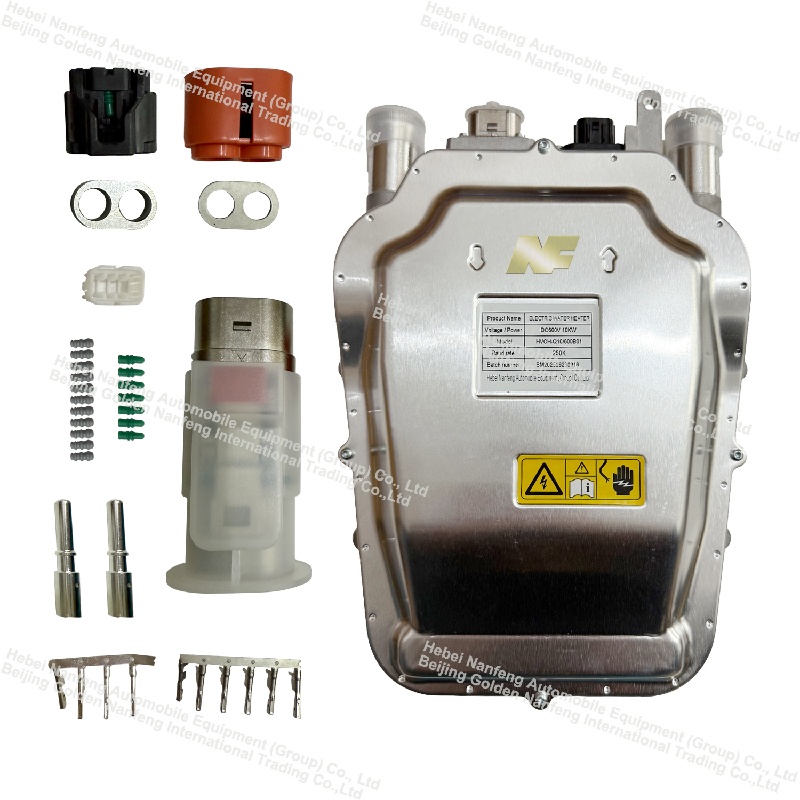
The core of Ev PTC heater relies on the material characteristics of PTC positive temperature coefficient thermistor, combined with the high-voltage power supply system and thermal management circuit of electric vehicles to achieve heating. Essentially, electrical energy is directly converted into heat energy, and then transferred to the cabin or battery through the medium (coolant/air). It has self limiting and self regulating characteristics throughout the process, without the need for additional complex temperature control devices, making it an efficient and safe heating solution for new energy vehicles.
The overall process is divided into two layers: core material principles and actual workflow for automotive use. The latter may vary slightly depending on the application scenario (cabin heating/battery heating). The mainstream for automotive use is liquid cooled PTC heaters (coolant heat exchange), while a small amount of cabin heating uses air heated PTC heaters (direct air heat exchange). The following are respectively explained:
1、 Basic core: Heating and self limiting temperature principle of PTC thermistor
The core heating element of PTC heater is PTC ceramic sheet (barium titanate based semiconductor ceramic doped with trace rare earth elements), which is the root of all its characteristics:
Heating: PTC ceramic chips form conductive paths with internal conductive grains at rated voltage (high voltage DC for automotive use, such as 300V+/400V+), generating Joule heat when current passes through, achieving direct conversion of electrical energy to thermal energy with high heating efficiency (close to 100%, no energy conversion loss);
Self limiting temperature (core characteristic): When the temperature of PTC ceramic chips does not reach the Curie temperature (critical temperature of materials, generally 120-180 ℃ for automotive use), the resistance value is very small, and continuous high current and high power heating occur, causing the temperature to rise rapidly;
Once the temperature exceeds the Curie temperature, the internal conductive path will rapidly break, and the resistance will increase exponentially (up to 10 ³~10 ⁶ times the resistance at room temperature). According to Ohm’s law (P=U ²/R), under constant voltage, the heating power will sharply decrease, and the heating rate will be lower than the heat dissipation rate. The temperature will naturally stabilize near the Curie temperature and will not continue to rise, avoiding dry burning and overheating from the root;
Self recovery: When the temperature drops below the Curie temperature due to heat dissipation (such as coolant/air flow), the resistance will quickly recover to a low resistance state, resume high-power heating, and achieve dynamic self-regulation of temperature power.
2、 Mainstream solution for automotive use: Working process of liquid cooled PTC heater (universal for cabin/battery heating)
More than 90% of electric vehicles use high-pressure liquid cooled PTC heaters (compact structure, uniform heat exchange, suitable for cabin warm air circuit and battery temperature control circuit), integrated into the coolant circulation circuit of new energy vehicles. The heating of the cabin and battery is only achieved by switching between different circuits of the same PTC heating system. The core process is the same, divided into four steps:
Power supply startup: The vehicle VCU (Vehicle Control Unit) sends a startup signal to the PTC heater based on the cabin air conditioning command/battery temperature sensor signal (if the battery needs to be heated below 5 ℃), and at the same time connects the power supply circuit of the vehicle’s high-voltage battery. The high-voltage DC power is input to the PTC heating element;
Electricity to heat conversion: PTC ceramic plates quickly generate heat under high voltage current, reaching operating temperature within seconds, and the heat is transferred to the heat dissipation chamber/heat exchange tube of the PTC heater;
Coolant Heat Exchange: The electronic water pump of the vehicle’s thermal management system drives the coolant to circulate in the heat exchange tubes of the PTC heater. After absorbing the heat from the PTC heating element, the coolant becomes a high-temperature coolant (usually 40-60 ℃, adjusted according to demand);
Heat transfer
Cabin heating: High temperature coolant flows into the warm air core inside the car, and the blower of the vehicle’s air conditioning pushes cold air through the warm air core. The cold air absorbs the heat of the coolant and becomes hot air, which is then sent into the car through the air outlet to achieve cabin heating;
Battery heating: High temperature coolant flows directly into the water-cooled plate/heat exchange circuit of the power battery pack, and uniformly heats the battery module through heat conduction, raising the battery temperature to a suitable charging and discharging range (generally 10-35 ℃), solving the problems of low-temperature endurance degradation and limited charging and discharging.
Addendum: After the coolant completes heat exchange, the temperature decreases and then flows back to the PTC heater through the pipeline to absorb heat again, forming a closed cycle and continuously heating; When the cabin/battery reaches the target temperature, the VCU cuts off the PTC high-voltage power supply and stops heating.
3、 Small scale solution: Workflow of wind heated PTC heater (only used for partial cabin heating)
The cabin heating of some micro electric vehicles and low-end models will use air-cooled PTC heaters (without coolant heat exchange, directly heating the air), with a simpler structure and a core process of:
High voltage input PTC ceramic heating element directly generates thermal energy;
The air conditioning blower blows cold air over the surface of the PTC heating element, and the cold air directly exchanges heat with the high-temperature PTC ceramic plate, becoming hot air;
Hot air is directly sent into the cabin through the air outlet to achieve rapid heating.
Disadvantages: Uneven heat transfer, prone to local hot air, and PTC heating element directly contacts the air, requiring higher dust and water resistance. Therefore, it is only used for low-cost small car models, and liquid cooling is used for mid to high end new energy vehicles.
Post time: Jan-30-2026


